
The S&P BSE Sensex dropped 207 points to end at 25,230.

At an aggregate level, the late ace investor's portfolio that was valued at Rs 32,445 crore as on March 31, 2023 is now worth Rs 35,979 crore.

The S&P BSE Sensex slipped 305 points to end at 25,400 and the Nifty50 dropped 87 points at 7,783.

Just when stocks are seen as invincible, we should worry, warns Akash Prakash.

Foreign investors, according to them, will now wait-and-watch how the economy takes shape in the backdrop of doubts over monsoon, interest rate trajectory and other global events such as the US - China trade war.

The S&P BSE Sensex shed 42 points to close at 25,838 and the Nifty50 lost 13 points to end at 7,899.

In a report on the rupee's depreciation, S&P said, "Revenue for companies that export and operate overseas would rise, because they would get more rupees for the goods and services they sell."

Unlike the race to buy airwaves by telecom companies, airports by infrastructure companies and city gas networks by energy companies, the race to develop super apps by consumer-facing companies in India has not brushed up against any regulatory issues. Officials at the ministry of electronics and information technology and at other regulators are happy they do not have to meddle in who among the Tata group, Reliance Industries Ltd, Flipkart or Paytm will manage to build an app that sweeps in customers. Unlike separate apps a customer uses on her mobile to order groceries, buy food or airline tickets or just make payments, a super app can perform all these functions.

The combined market-cap of all listed Adani group firms has plunged nearly Rs 7.11 trillion since January 24 when the Hindenburg report was made public.
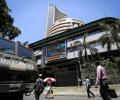
Bank Nifty pared all its intraday gains to end over 1% lower led by losses in BoB, ICICI Bank, Axis Bank and Bank of India

As regards India, FIIs have pumped in over Rs 34,400 crore in the Indian stocks in calendar year 2021.

A fall presents an opportunity to buy rate-sensitive stocks.

Experts feel select companies in banking, automobiles, financial services & real estate will gain from lower interest rates

'We believe 2017 could see higher flows from foreign institutions as money comes back to growth markets like India.'

Rate-sensitive sectors like banks, auto and realty witnessed strong buying demand in trades today

The market's sensitivity to the US Fed's balance sheet changes makes it vulnerable to the possible tapering of the bond buying programme and the resulting stagnation or even shrinkage in the balance sheet.

Monthly systematic investment plan (SIP) flows into India have held steady above Rs 13,000 crore in 2022-23 (FY23) in the face of markets delivering muted returns in 18 months. However, it is not a rose-tinted view when it comes to viewing new SIP registrations and the cessation of existing ones. The ratio of SIPs stopped as a percentage of fresh SIPs registered (called SIP stoppage or closure ratio in industry parlance) stood at 56 per cent in the first 11 months of FY23, compared with 41 per cent during the same period of 2021-22 (FY22).
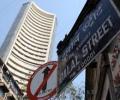
S&P upgraded India's credit outlook to 'stable' from 'negative' earlier.

Conventional wisdom is that when the US sneezes, emerging markets like India catch a cold. And yet the Indian stock market went up last year, points out Debashish Basu.

It's the first time in my memory that I have seen a negative expected return for equities, notes Akash Prakash. Hopefully, this implies the consensus is being too negative, and markets, as usual, will surprise everyone and deliver the least likely outcome.

'The market will focus on the fact that India does have strong earnings growth this year.'

The sharp correction in equity markets has taken a toll on mid-and-small cap stocks that have underperformed their large-cap peers. Thus far in calendar year 2022 (CY22), the mid-and-small cap indexes on the BSE have slipped over 8 per cent and 7 per cent respectively, as compared to a fall of around 6 per cent in the S&P BSE Sensex. While investors dumped mid-and small-cap stocks as the markets remained choppy over the past few weeks, analysts still expect these two segments to see good investor interest from a medium-to-long term perspective.

'We suggest an equity strategy of 5% to 10% exposure to cash, 5% to Gold ETF, close to 50% to Sensex/Nifty/large mid-cap stocks.'

Indian-American Deven Sharma, the president of Standard and Poor's, is stepping down by year end, an announcement coming only weeks after the credit rating agency downgraded American credit rating.

That means a manufacturer looking at a market like India needs to decide whether small, cheap cars or small, expensive cars or both will work better for them, says Pavan Lall.

India may see a structural shift in supplies of crude oil with Russia emerging as a key source of fuels, a development that reduces New Delhi's dependence on West Asian oil, gives Indian refiners better bargaining power with price-setter Saudi Arabia, and improves overall energy security. The unexpected surge in supplies of Russian crude in the last few months, unthinkable until the war in Ukraine, may also deliver other unforeseen gains such as boosting exports of refined fuels to Europe, which historically has counted on Russian shipments. India has jumped on to the bandwagon of opportunistic buying of Russian crude but if calibrated carefully, Urals crude can be a long-term asset for India refiners.

The BSE Midcap and Smallcap indices underperformed the largecaps and ended over 1% lower.

Omkeshwar Singh, head, Rank MF, a mutual fund investment platform, answers your queries:

Logistic players have seen a sharp correction at the bourses over the past six months as intense competition from new-age-tech startups, higher freight rates, and weak macros dented listed players' growth outlook. Analysts warn that the emergence of tech-based startups could weigh on organised players' profit-pool, and can potentially erode their market share. Thus, a stock-specific strategy would be prudent at this juncture with focus on companies that are rapidly innovating and investing in technology.

'Markets are not expensive; they are fairly priced.'

Infosys fell the most among Sensex stocks, declining by 2.85 per cent. Among other IT stocks, TCS fell by 1.87 per cent, Wipro by 1.52 per cent, and HCL Tech by 1.70 per cent. NSE Nifty plunged by 174.65 points to close at 17,938.40.

Traders are closely watching the progress of the monsoon.

The Sensex and the Nifty witnessed biggest one day loss in percentage terms since June 24

Domestic mutual funds (MFs) have kept their faith in the Indian stock market despite multiple headwinds all through 2022-23 (FY23), with their net flows into equities crossing the Rs 1.5-trillion mark for the second consecutive financial year. MFs pumped a net Rs 1.53 trillion into equities till March 1, 2023, the Securities and Exchange Board of India (Sebi) data shows, as compared to Rs 1.72 trillion in FY22. Since FY15, MFs have been net buyers of equities, except in FY21, when they sold a net Rs 1.21 trillion.

Thus far in 2017-18, FIIs and MFs have invested Rs 198.91 billion and Rs 1,119.49 billion in the Indian equity markets. Of this, around Rs 152.46 billion has come in January alone.

The S&P BSE Sensex ended up 28 points at 25,844 and the Nifty50 ended flat at 7,915.

Metals bucked the trend and shone across the board.

Global rating agency Standard and Poor's on Wednesday cautioned that large deficit economies including India could face more economic problems in the near term.

Broader markers outperformed their larger peers.

S&P also cut China?s GDP growth forecast to 7.5%t and that of rest of Asia.
